Wooden Bike Design Challenge

Fall 2021
Statics
Project Overview
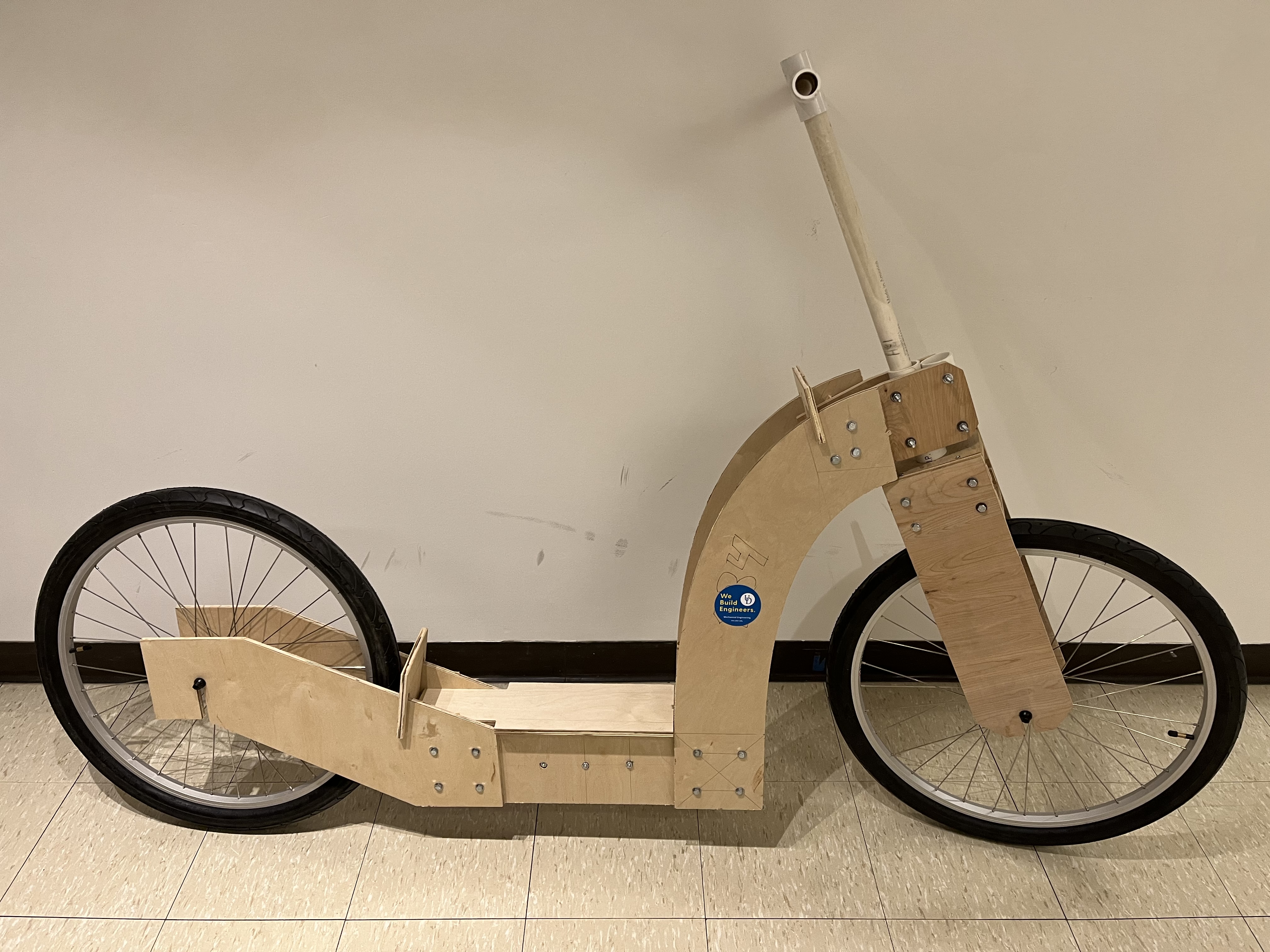
The goal of the project was to convert a single 4' x 4' sheet of 1/2" plywood (and 2 bike wheels) into a working bicycle able to support the weight of a rider. The end product was a functional kick bike design which was used to race against other teams (unfortunately, to no victory).
My Contributions
I was able to apply my background to form the concept of the kick bike as a fast, yet strong frame design. Using my CAD expertise, I formed a working CAD model to guide the construction process, of which I had a large part in doing. I was also able to perform basic analysis on the design such as determining the total volume/envelope size.
The constraints for the project were to create a bike which used only a single 4' x 4' x 1/2" sheet of plywood, 2 bike wheels, PVC pipe (for the front fork only), and various hardware to support a rider for an eventual bike race. In addition to this, the bike had to be safe (support a 175lb rider with a FOS of 1.5), compact (fit within a "travel bag" provided when disassembled"), weigh less than 30 lbs, cost no more than $55, and be easy to assemble. In addition to this, the bike was preferred to be stylish, fast, and comfortable to use.

The final design is modelled after a kick bike or a scooter which features no mechanical gears. A strong front fork was required as well as a sturdy base to support the rider, so an I-beam inspired frame was used throughout the assembly. Most of the frame is held by a simple square bolt pattern with spacing couplers added to prevent the design from splitting in two.
Final Design
Completed December 10th, 2021

From analyzing the final design, each of the target values created from the wants and constraints of the project were met. The frame composed of just 75% of the total alloted plywood and used 26 bolt assemblies. The factor of safety (FOS) of 1.5 was far exceeded by a FOS of bolt failure of 6.62 and a FOS of frame failure of 6.86 based on a static analysis. Approximately 55% of the travel bag was used to hold the bike giving it a great size, correlating to a product cost estimated to be around $30.68 due to the minimal materials used. In total, the frame weighed 17.5 lbs and required just 0.375 toal man-hours to assemble which makes it a relatively simple design as well. All in all, the product was a success and although it didn't finish first in the bike race, it greatly performed in each of the design specifications.

This project gave me a lot of experience in wood working and in design complex systems. I was able to perform background research on what is currently being done, formulate ideas from this, and then create a working product which meets the rigarous demands set by the project constraints. In addition to this, working as part of team helped my leadership skills in planning and coordinating complicated constructions and setting a division of labor to formulate, construct, and analyze a structure such as this.