Remotely operated underwater vehicles (ROUV's) have been in development since the mid-twentieth century, yet the overall method for buoyancy control in these vehicles has remained relatively constant. The majority of ROUV's on the market are composed of rigid bodies which greatly limits the maneuverability of these vehicles. While some ROUV's are seen to have more flexible body elements, buoyancy in almost all ROUV's is still primarily regulated by ballasts or pneumatically controlled systems which limits how often vehicles can resurface. Buoyancy, in general, is regulated by the average density of the submerged vehicle-- these ballasts act to increase the mass of the vehicle while maintaining a constant volume, but variable volume/constant mass ROUV's are rarely seen. More so, research behind changing the overall structure to an ROUV to control its buoyancy without relying on pneumatics is sparse. The purpose of this study is to explore the relationship between the neutral buoyancy state (i.e., the depth and orientation achieved while in neutral buoyancy) of an ROUV by structural deformations to the surface of the body. From this, the underwater maneuverability of this deformable membrane ROUV is explored.
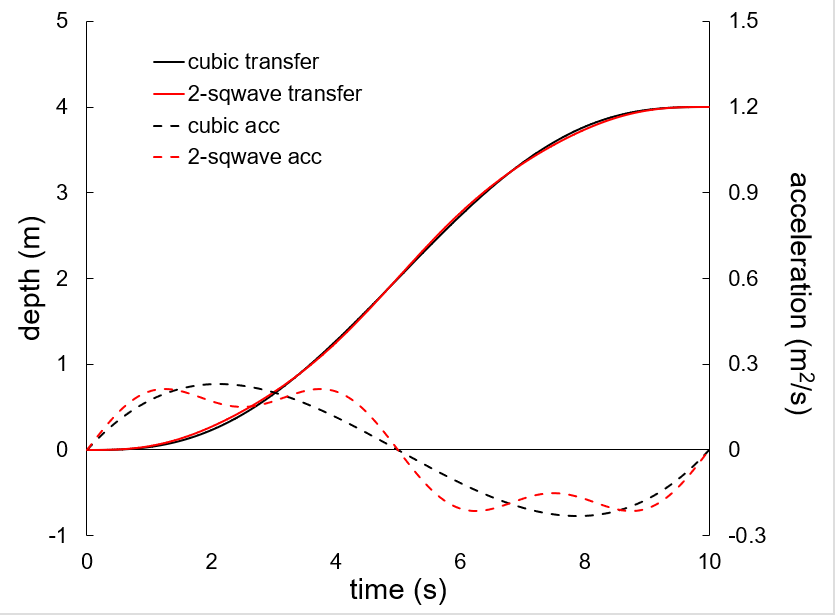
A novel design is created for this volumetrically-controlled buoyancy which features a cross-section with a corrugated membrane, hereafter called the Adjustable Corrugated Interface for Buoyancy Alteration (ACIBA). The feasibility of such a device is first evaluated by finite element analysis (FEA) using a numerical model for the cross section of the vehicle. The force of the water on the ACIBA structure is modelled by a uniform pressure acting on the exterior of the vehicle. For this calculation, the surface is parameterized to calculate the vector normal to each node, modelling the near constant hydrostatic pressure the ROUV would encounter. The inside of the vehicle is modelled as air, with a very low Young's modulus and Poisson's ratio to create minimal resistance. With this, a stress map is generated for the ACIBA to determine the best material for the membrane based on the loads subjected. Theoretical calculations are performed to determine the maneuverability of this vehicle, as well as how well the material is able to handle such mechanics. Next, additive manufacturing (3-D printing) is used to create a model of this theoretical ACIBA structure. Mechanical testing is performed to validate the simulated results and pressure testing is applied to further determine the practicability of this design. Based on the theoretical and experimental tests performed in this study, an ROUV with a deformable membrane can be controlled for maneuverability as well as maintaining neutral buoyancy state solely using these volumetric changes to the body. The corrugated, sinusoidal design featured in this study (ACIBA) is capable of performing various maneuvers such as depth transfers with realistic material constraints. Developments such as this to oceanographic equipment and vehicles are becoming increasingly important to marine sciences but also see cross-applications in the field of aeronautical and aerospace engineering. Structural deformities allow the novel design to reconfigure under high pressures which can affect the drag on the surface, possessing vital applications for aeronautics and the design of aircraft.